Showing posts with label busy executives. Show all posts

Saturday, February 27, 2010

Interval training as a time machine

image Twice the results in half the time? Where do I sign up?

That’s what Jan Helgerud, an exercise expert at the Norwegian University of Science and Technology, says is possible with interval training: alternating high intensity and low intensity bouts of exercise effort in one continuous session. For people with time constraints, it is the perfect solution. And, who doesn’t have time constraints?

Read the article, and then try these two ways of doing it to get started. No matter what exercise you do, all you do is alternate hard work with easy work---and move fast.

Interval cardiovascular workout

This is is basic as it gets. 30 seconds high, 30 seconds low, 10 minutes.

  1. Hop on an upright bike (or outdoor variety if you have a course that allows for speed and no interruption).
  2. Warm up at a moderately easy pace for 2 minutes.
  3. Starting at the 2:00 mark, and at the top of every minute, crank up the resistance until you have to stand up in the pedals and the revolutions per minute (RPM) count decreases at least 25% (e.g., from 90 pedal RPM to 65-70). Go for 30 seconds with very high intensity.
  4. After 30 seconds, crank the resistance all the way back down and recover.
  5. Repeat until you hit 10:00.

Interval resistance workout

A little more complicated, but it follows some other principles I have talked about in the past. You will be using antagonistic exercise pairings. That is a fancy way of saying using opposite muscle groups in two exercises back to back without rest. This one will deal with chest and back.

  1. Conduct your normal warm up routine.
  2. Use a moderately heavy weight that you could lift 10 times with good form.
  3. Perform a dumbbell bench press and do 6 reps.
  4. Immediately perform 6 reps on a lat pulldown machine (pull ups are better if you can do them).
  5. Rest 30-45 seconds.
  6. Repeat for 6 sets.

After both of these, you will be surprised at how wiped out you feel in just 10 minutes. Hmmm, guess it must be working.

Wednesday, April 22, 2009

View from the top

My good friend, Larry Bodine, is a brilliant business development coach and visionary on using the web to increase your exposure. He also happens to be a guy who constantly is looking for new challenges and experiences.

A few months ago, he asked me for some help on being able to do something basic: more  pull ups. We talked for a while, and I gave him some routines that I thought might help. A few weeks later, he let me know that his results improved dramatically. He also was filled with a sense of pride that he continued to improve week after week.

He recently sent me this note from his latest adventure (picture included):

Ventana Canyon - view from the top 1 I’ve been hiking a lot lately, and yesterday made it to the peak of Ventana Canyon.  It’s an 8-mile round trip, climbing up 1300 feet to the top, at 4240 feet.  At the end, the “trail” was a pile of rocks. I have a blister on my left foot, a sunburn, sore quadriceps, and a real sense of accomplishment.

Larry Bodine, Esq.
Apollo Business Development


Larry has a son out of college, a very busy consulting practice and is on the road constantly. However, he finds time for his next fitness challenge and accomplishment. Good for you, Larry.

Some people only have a two dimensional view of the world. They read about it in books or see pictures of it on the Internet. Larry has a 3D perspective of the world: he was there. And, the view is better from the top.

Monday, April 06, 2009

In this corner…

A number of women who are trying to balance career, family and some semblance of a normal life have a similar question for me: if I have to choose one thing to do to be healthier, what should it be?

Well, harkening back to my days as a consultant, I would say “it depends.” It depends on what you are trying to accomplish and what you consider to be success.

Woman’s Fitness magazine had an excellent article about how different methods, cardio or strength training, face off against each other. Here are the abbreviated results:

Getting rid of excess weight

Winner: Strength training. Cardio burns more per hour, but strength training keeps your metabolism elevated longer. In addition, each pound of muscle you add can burn up to 60 more calories per day whether you exercise or not.

Dealing with stress

Winner: Cardio. Think of runners high and the endorphins endurance activity produces.

Looking good naked (for lack of a better description)

Winner: Strength. You are permanently altering body shape. Enough said.

Injury prevention

Winner: Strength. Repetitive motions like running and cycling without strength training can lead to injury. Strength training helps the connective tissues deal with the pounding.

Living forever

Winner: Cardio. That heart muscle, and the systems connected to it, is pretty important.

Beating your personal best

Winner: It depends. Only you truly know what personal best you are trying to eclipse. Your training should be very specific to attaining that goal.

Wednesday, March 11, 2009

The First Lady’s first class arms

Talk about a great role model. The 44 year old first lady of the United States looks like she is 15 years younger. What is the secret to her success?

  1. She works out for 90 minutes, 3 times per week
  2. She has a personal trainer help her with her program
  3. She eats a balanced diet despite being tempted by lavish state dinners
  4. Her day starts with exercise as part of a standing routine

Intensity, discipline, consistency and focus. It really isn’t a secret. Read more here.

Friday, January 30, 2009

Wait just a second

I noticed today on my travels that it is easy to make the wrong choices about eating without even thinking about it. I had to fly from San Diego at 6:30 a.m., and my first stop after airport security ripped my bags apart was Starbuck’s.

I always get a basic coffee, but food choices are a bit challenging at Starbucks. There just aren’t a lot of good choices. I LOVE the blueberry muffins, but take a look at what is in them. It is like having Mom whip me up this great, old fashioned breakfast in terms of calories. However, I wolf it down in 90 seconds and get almost no enjoyment out of it.

Frequently, I might order it for no other reason than I am in a hurry. It is a simple choice that I am comfortable with making. But, if I take a step back and let one person go ahead of me in line, it gives me a moment to rethink it. I usually get a banana or their new oatmeal (big fan).

Five extra seconds could make the difference of needing to spend an extra hour on the bike today. I think it is a good use of my time to stop and think.

Tuesday, September 16, 2008

Does smart equal fat?

image Well, the title of this posting should get your attention. I have not lost my mind, but a new study by Laval University found that your mind engaging in deep thought might be responsible for a few of those extra pounds.

It seems that being at the office for 12 hours day AND engaging in heavy duty intellectual work is a double whammy against that bikini body you want. In the study, students who were offered all the food they wanted after difficult academic tests ate almost 30% more calories than those sitting on the couch. There was even a marked difference between students taking easy tests versus hard ones.

The research showed that blood glucose levels were actually lower after periods of deep thought, and the body demands glucose be replenished. The brain cannot produce its own glucose, and brain cells requires twice as much as other cells.

So, what does this mean for you if you have a job that requires you to be mentally sharp every day? As always, you need to have a strategy to compensate for it:

  • Realize that after a long day of thinking for a living, you are going to be starving. Do not chow down an entire Thanksgiving dinner 10 minutes after you get home. Eat slow and eat healthy.
  • Keep snacks in your desk drawer and eat a little something every couple of hours. One of those little sleeves of peanuts you get at the convenience store or a piece of fruit should do the trick. Don't let your brain glucose tank get too low.
  • If you think a lot, you are going to eat a lot. That means you need to exercise a lot. Pretty simple concept. So, do it.

Lawyers, bankers, executives, doctors all think for a living. But, being deep in thought all day can be dangerous to your health, so use that mental powerhouse of yours to make a plan to deal with the reality of being so profound.

Sunday, September 14, 2008

You have the time to workout (part 2)

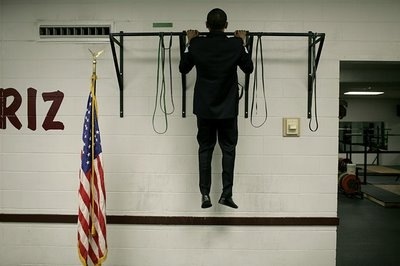
gg I am not trying to drive this concept into the ground, but if a presidential candidate can it the gym, so can you. What I liked about this article is the description of how Senator Obama breaks his workouts into several sessions throughout the day. Obama is a little bit on the ambitious side, so his dedication should not be a surprise. You can argue with his ideas and political policies, but you can't argue with his seemingly limitless vigor and capacity to handle the most arduous of schedules.

Coincidence? I doubt it.

Wednesday, September 10, 2008

12 Minutes

image I know you are busy. Your colleagues are watching. Your clients are demanding, and you demand the best from yourself. I understand that it is hard to find time to exercise and invest in your own fitness. For many people, it is lucky to make it into the Top 10 of your daily "to do" list.

All I ask is that you dedicate a few minutes a day to your own health. Less then 10 is not worth the bother. Fifteen or more feels like too much time. So, give me 12 minutes. Try one of the following when you feel like you just can't fit a workout in:

  • Run on a treadmill for 12 minutes. Warm up for two minutes and then start a moderate pace on a zero incline. Raise the incline every minute by one-half of a degree until you hit 12 minutes and try to maintain the same pace.
  • Pick one exercise for the following body parts (in this order): quadriceps, hamstrings, chest, back, triceps, biceps, abs. Now, perform 10 repetitions for each exercise, one right after each other, with no more than 15 seconds rest. Repeat one time.
  • Take your jump rope and complete the following circuit: 50 jumps, 10 pushups, 50 jumps, 10 crunches, 50 jumps, 10 lunges. Repeat this until the 12 minutes is up.

You are not going to win the Tour de France or give Michael Phelps a run for his money with these 12 minute routines. However, they will help you maintain your gains on busy days. Get creative and devise your own mix of exercises. All it takes 12 minutes, high intensity and the discipline to be consistent about it.

Thursday, September 04, 2008

Hunting down a gym

If you are a road warrior for work like me, you know how hard it is to try and find a decent gym when you are away from home. The recreation center I belong to at home is not Muscle Beach in Venice, CA, but it is where I feel most comfortable.

Use this simple tool to locate a facility that will cater to your location and needs when you are out of your comfort zone. I know from personal experience that having to use a crappy hotel gym, with equipment that looks like it is from the 1970's, is a big excuse for skipping a daily workout.

Once you find a place on the road you enjoy, make sure you book a hotel close to it from now on. You can always take a cab to your meetings in the morning. Most people won't take a cab across town to their workout.

Wednesday, September 03, 2008

Time for another plate (part 2)

In my last post, I discussed how to know when to increase the resistance on a particular exercise. In short, when it becomes easy, move up. So, how does this concept translate into helping your career?

Most people have heard the phrase in business that "if you are not growing, you are dying." I have two corollaries to this common sense axiom:

  1. If you are not learning, you are getting dumber. There is a reason that many professions require continuing education credits. The world changes. If you do not keep up to date on the latest changes, you cease to become a technical expert. You become a history expert. The same principle applies to knowing the latest scoop on your clients, competition and the market. If you are not constantly in front of the players, you are working with outdated information. In effect, you know less and less every single day.
  2. If you are not generating new business, you are losing business. Companies merge, clients are fickle and bad luck happens. Nothing is guaranteed in sales except the fact that you constantly need to prepare to replace clients. You will need to be able to adapt and adjust to remain effective against your competitors and other viable alternatives to your services.

In both corollaries, there is a common theme: when it gets easy, it is time to move up. The passage of time is the tyrant that demands your constant vigilance. With a fitness program, you can reach a desired state and try to maintain it. In your career, you can't because others are trying to take your gains away from you.

So, when you know the most you ever have and have more clients than you ever dreamed, it is too easy. Add another plate.

Wednesday, July 16, 2008

New job equals flab?

A recent study by CareerBuilder found that 45% of new workers have gained weight shortly after starting a new job. In fact 12% have gained more than TWENTY pounds.

There are many reasons for this. People tend to eat out more often, work long hours and skip their time at the gym when they are trying to become Masters of the Universe at their new gig.

Read this story to get some suggestions on how to avoid becoming a weight gain statistic. Sometimes being aware of what could happen is the best type of preventive medicine.

Friday, July 04, 2008

When you only have 30 minutes...

28_spinclass_lgYou are late for work, you missed your train, and you have back to back meetings all day. You are busy, there is no denying that. However, most rainmakers are busy. Have you ever met one that brags about the hours and hours of free time they have? Not likely. So, why do some of them seem to have time to exercise?

You probably could do some better time management, but I will let you sort that out. If the President of the United States can find time to run, so can you. Yes, I know, you can insert your favorite joke about the other political party here.

If you are pressed for time you need a strategy, contingency plans and a whole lot of intensity. Here is a quick article on a tough 30 minute cardiovascular workout. You can apply the same concept to resistance training. The key is to minimize rest, maximize intensity and get back to your pressing schedule as fast as possible.

Friday, June 27, 2008

Don't Let Calories Be a Bully--Push Back!

People do not set out to get fat. No one tries to make their butt get bigger over time. I have never heard someone say, "I am going to start now on a grand plan to be 30 pounds heavier just in time for my 20-year high school reunion."

I'll be honest with you. Managing your diet and caloric intake over time is not fun. It is a constant seesaw battle between good sense and good eating. I am not the person that will tell you that eating a few celery stalks is the same as eating a plate of nachos. It's not. Nachos taste a whole lot better (especially with guacamole).

However, the same could be said for a number of choices we make in life. Think about that roommate of yours in college whose textbooks right before mid-terms still made that new, crackling sound when you open them. Sure, it was easier to watch TV, start your weekends on Thursday at 2 p.m. and play Frisbee on the quad. Look where you are in your career today versus them. Choices matter, and sometimes you do not see the results until they are mercilessly compounded over time.

So, how do people end up 30 pounds heavier in 20 years? It is the results of bad choices compounded over time. Let's work backwards to see how most people get there...

  • 30 pounds of fat = 105,000 calories
  • 105,000 calories/20 years = 5250 extra calories per year
  • 5250 extra calories per year = 101 extra calories per week

That's right. If you consume the equivalent of one banana per week more than you need (or can burn with exercise), after 20 years, you will be 30 pounds heavier. I do not care if it is from carbs, protein or sticks of butter. Gaining and losing fat is a simple, mechanical process that is dependent solely on whether or not you consume more or less than you need to maintain your body's daily demands. How is that for "not fair"?

Most people get extra poundage from one of the following scenarios (some people participate in more than one):

  1. They eat way too much consistently on a daily basis relative to what their body actually needs. This is mostly due to bad choices (willpower) or caloric content/portion size (ignorance).
  2. They do not exercise on a regular basis or intensely enough to counteract occasional splurges.
  3. They are unaware of the "transactional" calories they are consuming throughout the day (20 extra calories here, 50 extra calories there, etc.).

The good news is that all of the above scenarios are under your control. There was a great article on MSNBC.com that talks about tactics to eliminate calories in increments of 100 or more. Read it and use the knowledge starting with your next meal.

Make no mistake: you are in a daily battle to keep those pounds off your beautiful body. As we age, become busier and get more sedentary in our lifestyles this gets even harder. So, when calories try to push you into becoming something you don't want to be, take control and push back!

Tuesday, June 24, 2008

You Probably Are Not as Busy as Her

I know, I know, we all are very busy people. Fitness tends to take a back seat to a number of other pressing issues (even though I cannot think of a more important issue than your health), but I do understand.

Take a minute, take your Bluetooth headset out of your ear, and let's put things things into perspective. We all have time for things that are important to us. I am sure doing that big deal or prepping for that big case is going to keep you awake for days. However, the prize (money, the spotlight and sense of accomplishment) is worth the effort.

Your personal fitness regimen is no different. Think of the prize instead of the arduous tasks that lead up to it.

You are no busier than the person in this article. Your career is no more important than this person's. I guarantee it. Somehow, she finds the time.

So can you.

Friday, June 20, 2008

ACSM: Realistic Goal Setting Helps People Stick with Exercise

The American College of Sports Medicine (ACSM) holds an annual conference each year, and this year it took place in one of my favorite cities in the world: Nashville, TN! If you have never been to Nashville, take a long weekend and hit the main drag on Broadway. Do not miss the upstairs stage at Tootsie's Orchid Lounge. However, you are going to seriously fall off your fitness wagon, so be prepared to make up for it the next week...

I encourage you to take a look at the ACSM's web site from time to time to see the treasure chest of scientifically-based information about fitness, performance and avoiding injury. Most of it is completely free and well documented.

One item I found interesting is the concept of setting small, achievable goals along as opposed to more challenging, long term goals. You can read the release by clicking here.

A former professor of mine gave me this great bit of advice once regarding splitting big tasks into smaller, bite sized pieces. He said, "If students were shown every test, quiz, paper, discussion and group project that they would be expected to do in the four years it took to complete a degree at university, NO ONE would ever enroll. It is too daunting of a task. So, always break it into mid-term or shorter segments. It is not about performance. It is mostly for maintaining your own sanity."

Great advice. It applies to litigating a big case, doing a huge deal or trying to lose 50 pounds over the course of a year (see, I got the fitness angle back in here).

Losing 50 pounds means you have to burn 175,000 calories. That equates to running for 125 hours at a 10 minute mile pace AND finding a way to cut almost 220 small meals (at 400 calories a piece) out of your diet. I think most people would rather think about that in a less intimidating way!

Here are some examples of small, achievable goals you should be setting along the way to your final destination:

  • Go from being able to do three pull ups to five pull ups by June 30
  • Lose eight pounds of body fat in the next 30 days
  • Reduce my calorie intake in my diet by 500 and burn 500 calories through exercise every day
  • Go from running one mile in 10 minutes to being able to run it in nine minutes (and enjoy it)
  • Burn 7000 calories through exercise in the next 14 days (if you miss a day, do more the next time)
  • Lower my cholesterol by 10 points

Take it one step at a time and keep stepping.

Wednesday, June 18, 2008

Accelerate Uphill

I originally published this on my friend Larry Bodine's online newsletter, Originate. However, after mentioning it in a few presentations, I got some requests to make it available here as well...


+++++++++++++++


When a cycling legend like Lance Armstrong comes upon a hill that would make even a goat need counseling afterwards, he has three choices. He can conserve energy until he reaches the top, try to continue at the same pace as before or accelerate uphill. What do you think his strategy would be?

He attacks the uphill.

He is not unlike anyone else who is trying to win instead of just finishing the race. Your position on the other side of the hill, and the long flat stretches that follow, are determined with each pedal stroke on the way up. What can we apply from cycling strategy to marketing and business development?

There are a great number of firms have been enjoying the downhill slope of the market for quite some time. This downhill slope is a metaphor for the relative ease it has been to continue to grow profits year over year in a seller’s market, which is similar to a competitive cyclist coasting down a steep hill. It does not mean they are not working hard, but most people would agree that trying to build a practice in an expanding economy is not as arduous as one where clients are much more aware of the fact that they really do have infinite choices.

However, with a looming slowdown in the business community, many lawyers are staring straight at an intimidating, uphill climb for the foreseeable future. What is your strategy? Should you conserve energy until you get to the top (cutting back on business development time and expenses)? Or, should you actually accelerate uphill (invest heavier in business development)? For the answer, let’s look at why Mr. Armstrong acts the way he does when faced with a similar choice.

Lance has been through a lot in his life, and he has won more than his fair share of contests. So, it is reasonable to think that he does not do things the hard way just for the extra challenge. He employs strategies that are proven time and time again.

Lance knows that extensive research has proven that cyclists who are trying to come out ahead, not just finish, must accelerate uphill. The main reason is that more time is added during the climb than can be taken back on the descent. Everyone can go fast on the descent, especially the larger riders that have more strength and weight.

Lawyers and law firms are subject to the same rules. The larger firms have more resources and people and are harder to overtake during times of plenty. Thus, it is competitively advantageous to accelerate uphill and make up any gaps in profitability when others may be coasting, conserving or just being plain lazy.

However, resources (time, money and attention) are finite, so lawyers need to invest in marketing and business development initiatives that are very focused on group of core contacts and have a measurable return on investment. Like a cyclist using a heart rate monitor or other digital training aid, you should be taking advantage of the latest technology since most of your competitors are.

Winners of the legal industry race will be using technology and digital strategies to be able to focus their efforts on this core group of your contacts, send them pinpoint messages on the topics most important to them individually and follow up with those that seem the most interested in what they are saying. Technology exists today to identify these people down to the individual. This allows a lawyer to spend more time building loyalty as opposed to general awareness. In other words, you should be visiting and talking with your best clients instead of broad prospects more than ever.

This technique for cyclists, known as variable power strategy, means you gain ground and overtake your competitors on the uphill slope. It has been demonstrated that it results in the fastest times. In fact, the steeper the hill, the more effective the strategy is. The same holds true for lawyers facing a slowdown in the economy.

Slowdowns favor the more nimble firm or adaptable lawyer. According to the aforementioned study, “…large cyclists can achieve greater downhill speeds, but overall performance still favors smaller cyclists on hilly courses.” In other words, those that can quickly adapt to the change in the course has the advantage over the hulking megafirm that has to carry all that weight uphill.

++++++++++++++++++
Reference
Swain, D.P. Cycling: Uphill and Downhill. In: Encyclopedia of Sports Medicine and Science, T.D. Fahey (Editor). Internet Society for Sport Science: http://sportsci.org 6 Nov 1998.

Monday, June 16, 2008

Common weightlifting mistakes

Let's say one day I decided that I wanted to start practicing law. I had been thinking about it my whole life, I watch a lot of Law & Order and how hard could it really be? Everything I need to know is written in a book somewhere.

Which one of you would like to be my first client?

[sound of crickets]

No one would expect that I would be very good at it because I am a novice, untrained and bound to make some mistakes along the way. However, that is why you hire experts (lawyers) to help you with the law. You don't try to figure it out yourself.

Do you try and do the same thing with your fitness regimen? Read the following article on Newsweek and think about whether or not you commit these common errors. I see them every day at the gym, and it really does not seem to matter how many years a person has been exercising.

The Four Worst Weightlifting Blunders

As the old legal adage goes, anyone who attempts to defend himself has a fool for a client. This applies equally when it comes to your activities at the health club if you do not have the expertise or experience. Seek out a professional who is as much of an expert in your field as you are in yours.

Saturday, June 14, 2008

Diet Strategy for the Road Warrior


If you frequently find yourself away from home working on that big deal or legal matter, you know as well as I do that eating healthy is a challenge. You are tempted at every restaurant by meals you would never dream of preparing at home and encouraged to overeat by colleagues and clients. Men's Health magazine published a great article on simple strategies that everyone can do to try and contain the collateral damage you can do to your body in just a few short days when you are away from your nutrition comfort zone.


YOU are in control of what you eat. You have worked hard for your results, so don't let the demands of visiting your clients infringe upon your hard fought gains.

Friday, June 13, 2008

Machines? Free weights? What should you use?

Check out the following link to an article that talks about the dilemma almost everyone faces if they spend time in a gym: what type of equipment should I be using (if any) to get the best results?


By the way, rainmakers, this is usually a bigger problem for you. Part of being so successful in life is finding every advantage you can to get better results. This applies in your career as well as your fitness routine. I talk to people all the time who are convinced there is a "better way" to do things when it comes to exercise. They are looking for that new routine, new piece of equipment or new methodology that is going to unlock the buff body treasure chest for them.

This also is directly correlated to time management issues. Rainmakers want the latest and greatest especially if it gives better results in less time.

So, what is the scoop? Free weights give you a more intense workout because you are required to stabilize the resistance yourself. Therefore, it makes sense that you will burn more calories and create more stress on your body. Stress is good when it causes the body to adapt for the better. It is bad when it hurts your joints or leads to cumulative trauma injuries.

Machines are great for stability and safety, and they also tend to isolate specific muscles. However, when in life do you do isolated muscle movements? When you pick up a heavy box out of your car, do you use just your biceps? No, you do a compound movement that might include your legs, arms, lower back as well as your core to balance yourself in an awkward position.

Rainmaker rule: within reason, making things harder creates more intensity and gives better results.
  • Every point of contact with the floor, bench or other means of support decreases intensity (think of doing a bench press while laying on a bench versus a stability ball).

  • Having the weights move in a fixed range of motion (think of a bench press machine versus free weight dumbbell bench press) decreases intensity.

  • Using a lower number of recruited muscle fibers (isolated movements like a bicep curl versus a pull up) decreases intensity.
Decreased intensity means it takes longer to get the same results. Longer time is the big enemy of the rainmaker.

So, machines have their place, but they certainly do not RE-place free weights and other unsupported movements that will get you better results in less time.

Monday, June 09, 2008

Keeping a journal keeps you on track

Keep a wellness journalSo, let's say for the sake of argument that you are pretty dedicated to your exercise routine, make an effort to eat healthy and stay as active as possible. Are you keeping track of all of it? You should be.

A wellness journal is an important tool for long lasting health and fitness. It helps you keep track of your progress, identify obstacles or roadblocks and provide a method to plan your next week's activities in advance. Here are some examples of what a wellness journal can help you with:

  • Do Monday meetings sap your energy for late afternoon workouts? Do you tend to skip them? If so, adapt your routine to exercise on Monday's as soon as you wake up or make it a regularly scheduled day off from the gym.


  • Are you making significant, upper body strength gains or are you stuck on a plateau? Looking back in your journal may show you are relying too heavily on resistance machines and may need to vary your workout.


  • You have a three day trip to New York this week and will be stuck in all day meetings. You also have to wine and dine your clients each night. You should already be planning for what you will be doing three days in advance as well as three days after your trip to accommodate for it.

Think about it in terms of your career: do you have the option to just "wing it" when it comes to recording your time, thoughts, notes or key action items? Rainmakers don't do that. If they did, they would not stay rainmakers for very long! So, apply the same rules you have for professional responsibility to wellness responsibility. Keep a journal and use it as a forward thinking, strategic guide.